

Standard English Conventions on the SAT: Punctuation and Grammar Rules That Earn Points
- prabaram1
- May 21
- 11 min read

Your student keeps losing the same handful of points on Digital SAT practice tests and can't name which rule keeps tripping them up. This guide fixes that.
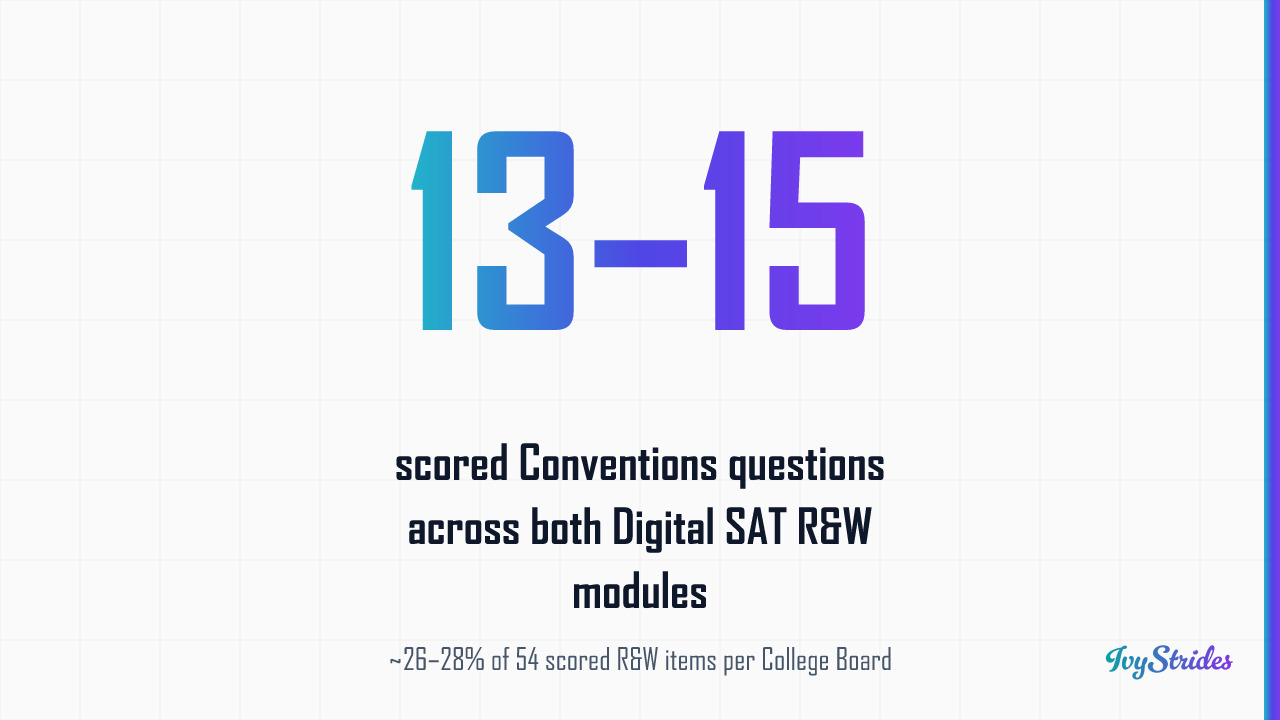
Standard English Conventions is one of four content domains on the Digital SAT Reading and Writing section, and it tests a finite set of rules grouped into two categories: Boundaries (when to use commas, semicolons, colons, dashes, and periods between clauses and phrases) and Form, Structure, and Sense (subject-verb agreement, pronoun-antecedent agreement, verb tense, modifier placement, and parallel structure). Conventions makes up roughly 26 to 28 percent of R&W questions, which means 13 to 15 of the section's 54 scored items. Because the rules repeat, this domain is the highest-yield place on R&W to earn points fast.
What Standard English Conventions Actually Tests on the Digital SAT
The Digital SAT Reading and Writing section is split into four content domains: Information and Ideas, Craft and Structure, Expression of Ideas, and Standard English Conventions. Per College Board's Digital SAT specifications, R&W runs as two adaptive modules of 27 questions each, all built around short discrete passages.
Conventions sits at roughly 26 to 28 percent of R&W items. That translates to 13 to 15 scored questions across both modules combined. It's a meaningful chunk, and the rules don't change from test to test.
You'll know a Conventions item the moment you read the stem. It uses one consistent phrasing: "Which choice completes the text so that it conforms to the conventions of Standard English?" When you see that wording, the four answer choices will differ only in punctuation, verb form, or pronoun. No interpretation. No tone judgment. Just rules.
For a deeper map of the test structure, see how the Digital SAT's adaptive modules work and the full Digital SAT format breakdown.
The Two Categories: Boundaries and Form, Structure, and Sense
Every Conventions question falls into one of two official subcategories. Being able to classify a missed item in five seconds is the foundation of targeted drilling.
Boundaries items test how to punctuate between clauses and around supplementary elements. Look at the answer choices. If they differ only in commas, semicolons, colons, dashes, or periods (sometimes mixed with conjunctions like and or but), it's a Boundaries question.
Form, Structure, and Sense items test agreement, verb form, modifier placement, parallel structure, and noun agreement. The answer choices will differ in verb endings (is vs are, has vs have), pronouns (it vs they, its vs their), or word order around an opening phrase.
That single classification step is what separates students who improve from students who keep guessing. Sort first. Apply the rule second.
Boundaries Rule Sheet: Commas, Semicolons, Colons, Dashes, and Periods
Here's the decision tree. Drill it until it runs in the background.
Rule 1: A comma alone cannot join two independent clauses. This is the comma splice, and it's the single most-tested error on Boundaries items. An independent clause has a subject and a verb and could stand alone as a sentence. Two of them glued together with just a comma? Wrong every time. The lab results were inconclusive, the team ran a second trial. That's a splice.
Rule 2: A semicolon joins two independent clauses that could each stand alone. Swap the semicolon for a period. If both halves still work as full sentences, the semicolon is correct. The lab results were inconclusive; the team ran a second trial. Both halves stand. Valid.
Rule 3: A colon follows a complete sentence and introduces a list, explanation, or definition. Test it the same way. Read everything before the colon. Is it a full sentence on its own? If yes, the colon is fair game. If no, the colon is wrong.
Rule 4: Paired punctuation around a supplementary element must match. A supplementary element is a non-essential phrase that interrupts the sentence. Surround it with two commas, two dashes, or two parentheses. Never mix the pair. The biologist, who had studied the species for years, published her findings. Two commas. Matched.
Rule 5: A dependent clause attached to an independent clause usually takes a comma when it comes first, no comma when it comes second. Because the data was clean, the analysis took two days. vs The analysis took two days because the data was clean.
Worked example. Stem: "Which choice completes the text so that it conforms to the conventions of Standard English?" Choices:
A) findings, the team published
B) findings the team published
C) findings; the team published
D) findings: the team published
If the first half ("After reviewing the findings") is a dependent phrase, the answer is A (comma after a leading dependent element). If the first half is a full independent clause, the answer becomes C or D depending on what follows. You don't guess. You apply the test.
Form, Structure, and Sense Rule Sheet: Agreement, Verb Form, Modifiers, Parallelism
This is where most students at the 1100 to 1400 band leak points without realizing it.
Subject-verb agreement. The verb must match the subject in number. The trap: prepositional phrases between the subject and the verb. The collection of rare manuscripts ___ housed in the east wing. The subject is collection, not manuscripts. Singular. So: is housed. Cross out the prepositional phrase before you pick the verb. Every time.
Pronoun-antecedent agreement. A pronoun must match its antecedent in number. Collective nouns (committee, team, company, jury) take singular pronouns in the standard American usage tested by the SAT. The committee published its report, not their report. Also watch its vs it's. Possessive its has no apostrophe. Contraction it's means it is.
Verb tense consistency. Anchor every verb to a time marker in the sentence. In 1923, the geologist mapped the region and publishes her findings. The shift from mapped (past) to publishes (present) breaks tense. Both verbs must sit in the same time frame unless the sentence explicitly signals a change.
Modifier placement. The noun directly after an opening modifier phrase must be the thing that phrase describes. Walking through the museum, the sculptures impressed the visitors. Wrong. The sculptures weren't walking. Fix: Walking through the museum, the visitors were impressed by the sculptures. This is the dangling modifier, and it appears on almost every Digital SAT form. Squinting modifiers, where a word could attach to two different things, also show up. Read the opening phrase, then check the very next noun.
Parallel structure. Items in a list or comparison share grammatical form. The researcher enjoys hiking, swimming, and to bike. Broken. Fix: hiking, swimming, and biking.
Noun agreement. When a sentence refers to a group of people each doing one thing, the noun count should reflect that. The students raised their hand sounds off because there are many students; the SAT will test the plural form hands.
The Student Keeps Missing the Same Conventions Questions: How to Diagnose Your Weak Spots
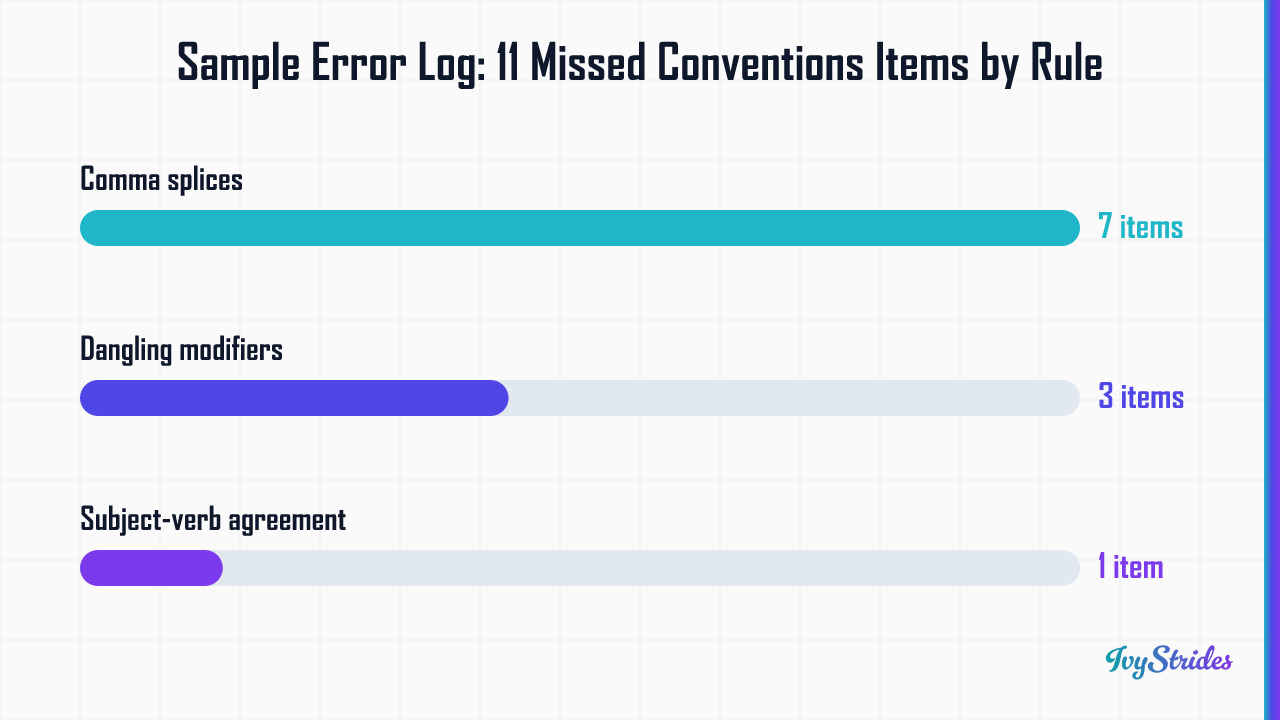
Here's the part most students skip. They take a practice test, see they missed eight Conventions items, feel bad, and re-read a grammar book. That doesn't work. The fix is forensic.
After every practice section, tag each missed Conventions item twice. First tag: Boundaries or Form, Structure, and Sense. Second tag: the specific rule (comma splice, subject-verb, modifier placement, parallelism, and so on). Keep a running error log by rule.
In our coaching with students at the 1100 to 1400 band, 60 to 80 percent of a student's Conventions losses cluster in just two or three specific rules. A junior we worked with last fall came in at a 1280 baseline and was missing 11 of her 14 Conventions items across two modules. Once we logged them, the pattern was obvious. Seven were comma splices. Three were dangling modifiers. One was a subject-verb trap with a long prepositional phrase. After four weeks of targeted drilling on those three rules, she recovered all 11 items on her next full-length practice test.
That matters for scoring. A diagnostic surfaces which R&W domain is the actual point-leak, so a student who is missing six Conventions items per module knows exactly where 60 to 80 R&W points are sitting. At mid-bands, recovering one Conventions item can typically move the R&W scaled score by 10 to 20 points in our coaching, because the second adaptive module gets harder when you perform better on Module 1.
If your student's reading score has plateaued, see why your SAT Reading score isn't improving for the broader pattern.
Find the exact Conventions rules costing your student R&W points Book a free 15-minute strategy call. We will review a recent practice test, name the two or three rules driving most of the loss, and map a path to the next score band. Book a Free Strategy Call
How Conventions Points Differ From Math Points (and Why That Matters for Prep)
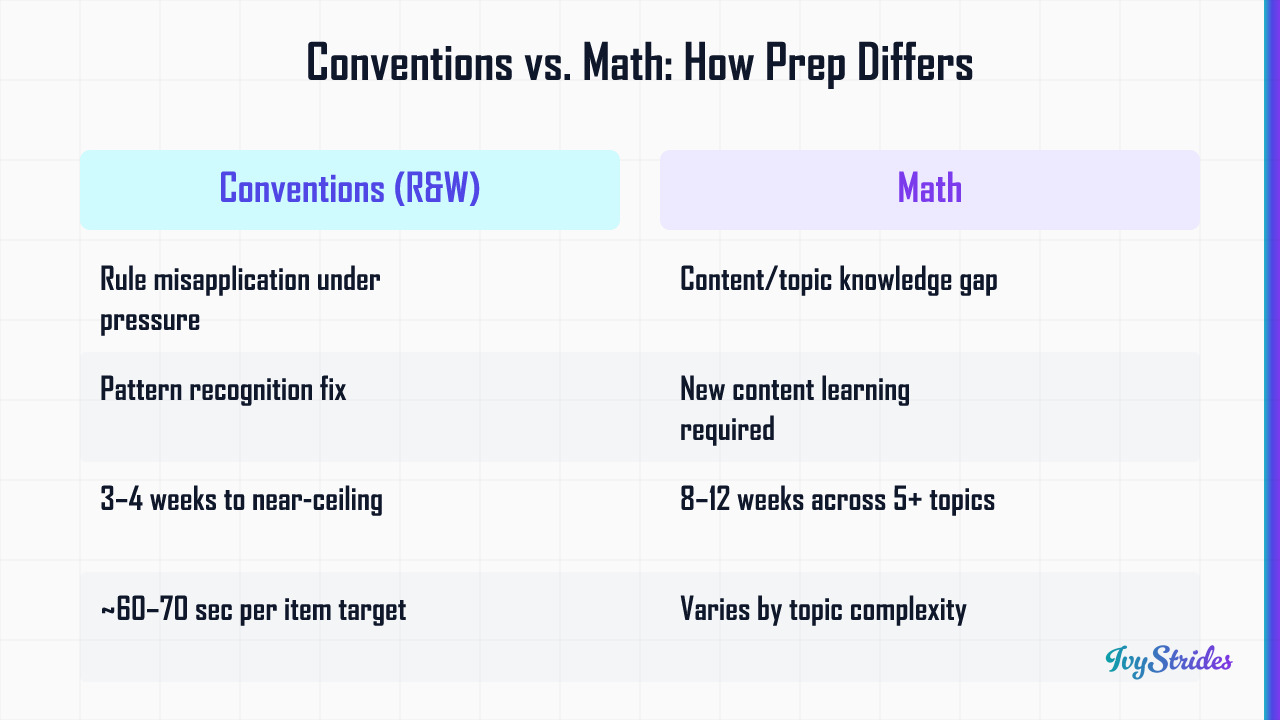
R&W and Math share pacing logic but diverge in error-pattern diagnosis: Math errors usually trace to a specific topic gap, while Conventions errors almost always trace to a misread of one of a few dozen punctuation or agreement rules.
That distinction changes the prep plan. If a student is losing points on quadratics or percent setups on the Math section, the fix is content. They need to learn the topic. That can take weeks. See SAT Math topics for 2026 for the full Math content map.
Conventions is different. The student already knows what a comma is. They just misapply the rule under time pressure. The fix is pattern recognition, not new content. Which is why Conventions can be drilled to near-ceiling faster than Math content gaps. In our coaching, a student moving from missing 8 Conventions items to missing 1 or 2 is typically a 3-to-4-week project. A student moving from missing 8 Math items distributed across five topics is more like an 8-to-12-week project.
Pacing matters here. Target roughly 60 to 70 seconds per Conventions item in Module 1, banking time for harder Module 2 Information and Ideas questions that genuinely require slower reading.
Pacing and Module Strategy for Conventions Items
Each R&W module gives you 32 minutes for 27 questions. That averages to about 71 seconds per question, but Conventions items should run faster than the average so you can spend the saved time on Information and Ideas inference questions.
Order of operations on any Conventions item: read the stem, look at what varies in the four answer choices, apply the relevant rule, pick, move on.
Here's a shortcut that works on Boundaries items. If three of four choices contain a comma splice or a fragment, the fourth is almost certainly correct. Scan the choices first. If three of them join two full sentences with just a comma, eliminate all three and verify the fourth.
Skip-and-flag any item that takes more than 90 seconds. Come back at the end. Burning two minutes on a single Conventions question while three Information and Ideas questions sit unread is a net loss every time.
For broader pacing benchmarks, see SAT reading speed targets.
A 4-Week Drill Plan to Master SAT Standard English Conventions
This plan assumes the student has 5 to 7 hours per week to dedicate to R&W. Adjust if you have more or less. The methodology, diagnostic plus targeted weakness work plus spaced retesting, is the same one our section-specialist R&W coaches run with 1-on-1 students.
Week 1: Diagnose. Take one full-length Bluebook practice test under timed conditions. Review every missed R&W item. Tag each Conventions miss as Boundaries or Form, Structure, and Sense, then by specific rule. Build the personal error log. Honest framing: if Conventions is not your biggest leak, redirect the plan. Sometimes Craft and Structure or Information and Ideas is the real bottleneck.
Week 2: Boundaries deep work. Focus on independent vs dependent clauses, semicolon use, colon use, paired punctuation around supplementary elements. Do 40 to 60 mixed Boundaries items with full review. After each missed item, write down the rule that should have applied. Don't just check the answer.
Week 3: Form, Structure, and Sense deep work. Subject-verb agreement (especially with long prepositional phrases), pronoun-antecedent agreement (especially collective nouns), modifier placement, parallelism, verb tense consistency. Same volume: 40 to 60 mixed items with full review.
Week 4: Integrate. Two timed module practice runs early in the week, then a full-length practice test to confirm retention. Re-log any missed Conventions items. If the same rule shows up that you drilled in Week 2 or 3, you haven't internalized it yet. Loop back.
Honest framing on outcomes. In our coaching with students completing the program, typical SAT 200+ improvements take 60 to 100 focused study hours across all four R&W domains plus both Math domains, not Conventions alone. Conventions mastery is a piece of that total, often the fastest-improving piece, but a strong SAT is one part of a full college application. Test-optional policies vary by school and year, so check each target school's current policy. No coaching program can guarantee a specific score or admission outcome.
For the integrated study plan, see build a full SAT study plan and the SAT study guide for 2026.
FAQ
How many Standard English Conventions questions are on the Digital SAT?
Roughly 13 to 15 of the 54 scored R&W questions test Conventions, distributed across both adaptive modules. Per College Board's published domain weightings, Conventions represents 26 to 28 percent of R&W items. Exact counts per module can vary slightly between forms.
What is the difference between Boundaries and Form, Structure, and Sense questions?
Boundaries tests punctuation between clauses and around supplementary elements: commas, semicolons, colons, dashes, and periods. Form, Structure, and Sense tests agreement (subject-verb, pronoun-antecedent), verb tense and form, modifier placement, and parallel structure. The fastest way to tell them apart is to look at the answer choices. If they differ in punctuation marks, it's Boundaries. If they differ in verb endings, pronouns, or word order, it's Form, Structure, and Sense.
When should I use a semicolon on the SAT?
Use a semicolon only to join two independent clauses that could each stand alone as a complete sentence, or to separate items in a list that already contains commas. The quickest test: mentally replace the semicolon with a period. If both halves still read as full sentences, the semicolon is correct. If either half is a fragment, it's wrong.
How do I spot a comma splice in an SAT answer choice?
Check whether a comma sits between two groups of words that could each stand alone as a complete sentence. If yes, that answer is a comma splice and it's wrong on a Boundaries item. The fix in the other choices will usually be a semicolon, a period, or a comma plus a conjunction like and, but, or so.
How do I fix subject-verb agreement when the subject is buried far from the verb?
Cross out every prepositional phrase between the subject and the verb before you pick. The collection of rare manuscripts from the 18th century ___ housed in the east wing. Strike out of rare manuscripts and from the 18th century. What's left: The collection is housed. Singular subject, singular verb.
How do I recognize a dangling or misplaced modifier in 30 seconds?
Read the opening phrase. Ask: who or what is doing this action? Then look at the very next noun after the comma. If that noun is not the doer, it's a dangling modifier. Walking through the museum, the sculptures impressed the visitors. The next noun is sculptures, but sculptures don't walk. Wrong.
How many Conventions questions appear in each Digital SAT module and how should I pace them?
Conventions items are distributed across both modules of 27 questions each. Target 60 to 70 seconds per Conventions item so you bank time for slower Information and Ideas questions. Skip and flag any item that takes more than 90 seconds.
Is Standard English Conventions the easiest part of R&W to improve?
For most students at the 1100 to 1400 band, yes, because the rules repeat and are finite. In our coaching, a student can move from missing 8 Conventions items per section to missing 1 or 2 in roughly 3 to 4 weeks of focused drilling. That said, a diagnostic should confirm where the actual point-leak sits before committing weeks to Conventions work. If a student is already missing only one or two Conventions items, the bigger gain is elsewhere.
Where can I get official Standard English Conventions practice?
College Board's Bluebook app and official Digital SAT practice tests are the closest match to live test items because they use the actual scoring algorithm and the same stem language. Supplement with targeted rule drills from a quality prep resource, but always validate progress against official Bluebook practice tests.
Where to take this next
Conventions becomes the most predictable scoring opportunity on R&W once a student stops reviewing grammar broadly and starts drilling the two or three rules that actually account for their losses. The hard part isn't the rules. It's the diagnosis.
Turn Conventions into your most reliable R&W points A 1-on-1 SAT R&W coach will diagnose the exact rule patterns, build a four-week drill plan, and pressure-test it under timed module conditions. Start with a free 15-minute call. Book a Free Strategy Call


Comments